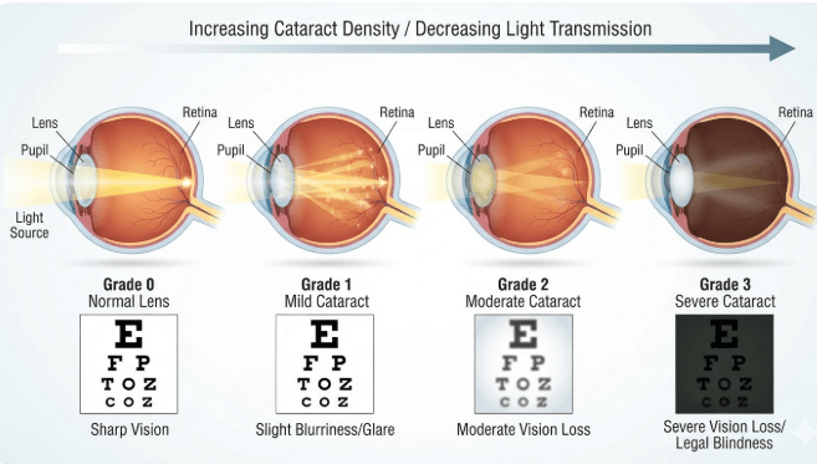
Before knowing what cataract is one must understand that every human being is going to get cataract as it is an age related change in the natural lens. Difference is some people get it relatively early and some lucky ones might not get it upto late 80s
SO WHAT HAPPENS WHEN CATARACT DEVELOPS?
The light which goes from your transparent natural lens, creates a sharp focus on retina of the eye and you see the world clearly.
As cataract develops less and less light goes inside and vision becomes less clear or hazy. Sometimes light spreads out because of cataract.
WHAT IS THE TREATMENT FOR CATARACT?
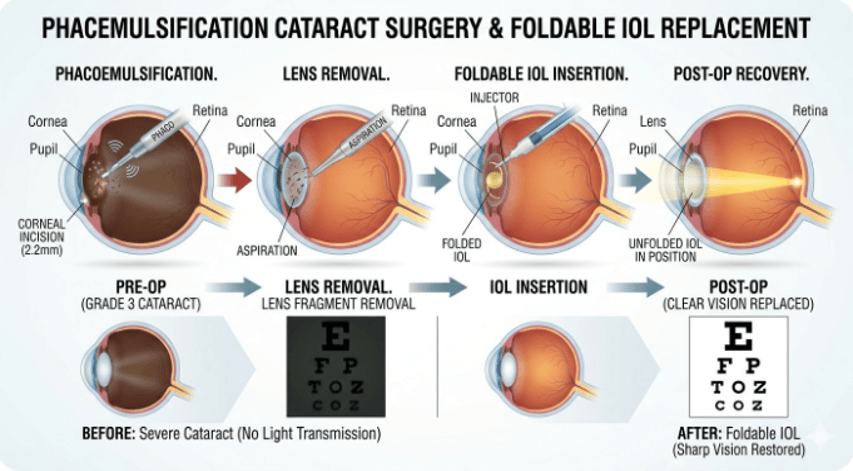
OPERATION is the only solution for cataract till now
Now a days cataract surgeries are one of the safest & most successful surgeries.
Here your cloudy lens is removed with help of ultrasound and laser energy and is replaced with foldable artificial lens known as intraocular lens.
MOST IMPORTANT : WHICH INTRAOCULAR LENS IOL (ARTIFICIAL LENS) TO IMPLANT?
There are three types of artificial IOL
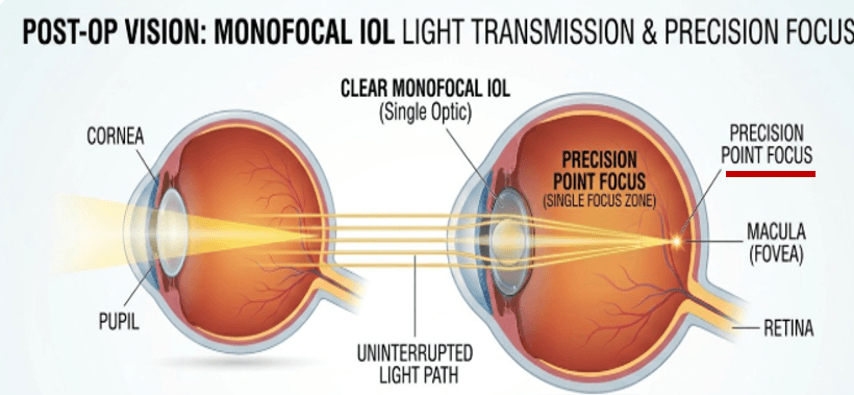
MONOFOCAL IOL
Creates sharp focus on retina
No light lost , so contrast sensitivity is preserved.
Good in low lighting, evening and night time
No glare/haloes
Disadvantage :
Need near glasses – for computers, reading, seeing dashboard of car, kitchen work
EDOF IOL
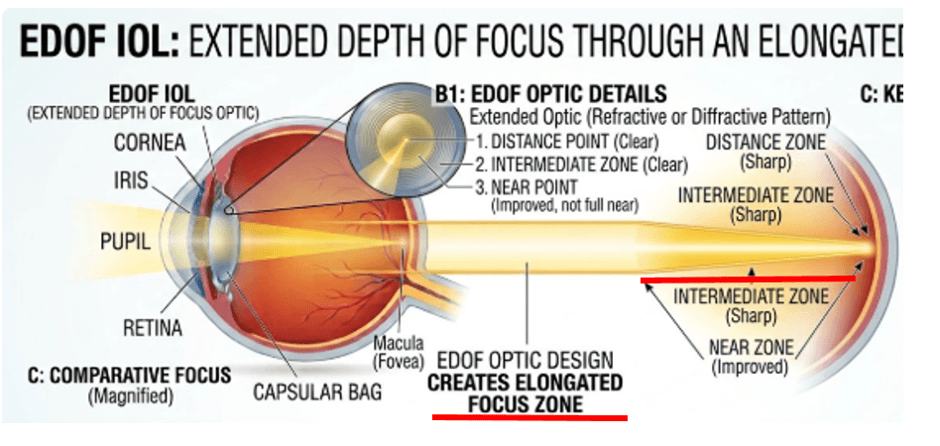
Extended depth of focus creates an elongated focus on retina instead of a single sharp focus.
Advantage it gives better intermediate vision than monofocal. One can see car dashboard, many times computer screen, kitchen work is easy. It also needs less power for near vision i.e reading.
Disadvantage: focus is not as sharp as monofocal IOL because there is mild loss of contrats sensitivity. Vision in evening time will be less sharp as compared to monofocal.
Tip: one needs to give 8-12 weeks for brain adaptation to new lens and its system. Also when both eyes are done patients gets maximum benefit.
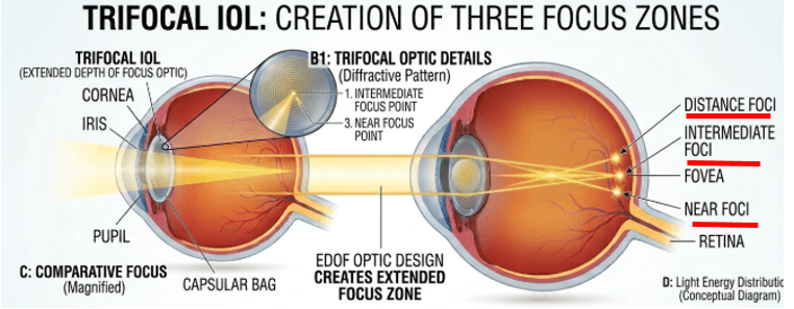
TRIFOCAL / MULTIFOCAL IOL
Light is divided into three foci. One is for distance, one for intermediate, one for near.
Advantage: You are glass independent for all distances.
Disadvantage: Trade off is it gives slightly lesser sharp vision, it causes halos, glare so night driving is very challenging.
You need to give 3-6 months for your brain to adapt to this new complex system of IOL
HOW TO CHOOSE AN IOL?
It depends on various factors
- What is your visual demand
- What is your profession, means how much time you sit on computer, how much night driving you do, whether you like playing sports
- What is your personality, type A or relaxed easy going?
- Status of your retina and cornea
- Status of presence of dry eye
- Is there any associated issues like thyroid disorder, diabetes or hypertension
- your budget . If you have insurance mostly monofocal iols get covered but premium iol may not fully get covered and one has to pay out of their own pocket.
So after considering all these points we discuss in depth with patients and help them choose the right IOL according to their need.
Never just go by EDOF or multifocal or glass independence or imported or robotic words. These are fancy words, discuss with your doctor in detail as every IOL has its advantages and disadvantage and there is always some trade off which generally are not told or discussed and then only go for your cataract surgery in Bopal, Ahmedabad.
Wishing everyone lifetime of good vision!!!
DR SHEETAL MAHUVAKAR
S M EYE INSTITUTE